


EdTech Congress Barcelona 2027 – Spain
What to expect
EdTech Congress Barcelona is a major meeting point for education, technology, training and innovation, bringing together education leaders, school and university executives, public administrations, technology companies, researchers and professionals involved in learning and digital transformation. The event combines conferences, exhibitions, workshops, demonstrations and networking, creating a space where educational challenges can be discussed alongside practical technology solutions. The official organizer describes the congress as a European meeting point where education leaders, technology and institutions connect to transform learning.
The upcoming edition is being presented under the theme “Learning realities: new horizons in a diverse world,” while artificial intelligence, educational technology, digital transformation and the changing realities of learning remain central areas of interest. The event is designed for different parts of the education ecosystem, including K-12 education, vocational training, universities, corporate learning, public administrations and digital-infrastructure professionals.
Education leaders
Enjoy Your Event Stress-Free with Spain Travelo
Planning a trip around a festival, concert, cultural celebration, or business event in Spain can be time-consuming—finding tickets, accommodation, transportation, and local information takes effort. Spain Travelo makes it easier by bringing essential event information, travel planning, and support together in one place.
School directors, university leaders, training executives and education policymakers can examine emerging approaches to digital transformation and discuss how technology can support learning outcomes.
EdTech companies
Technology companies can demonstrate products, educational platforms, artificial intelligence applications, digital learning tools and other solutions directly to a qualified audience of education decision-makers.
Practical learning
The congress combines high-level presentations with workshops, parallel sessions, technology showrooms and interactive experiences, allowing attendees to move from strategic discussions to practical examples.
Research and reflection
A major purpose of the event is to connect research, educational practice and institutional decision-making rather than treating educational technology as a purely commercial subject.
Event dates
EdTech Congress Barcelona 2027 will take place from 3 to 4 February 2027 at Fira Barcelona Montjuïc in Barcelona, Spain. The official event website confirms the dates and identifies Hall 8 at the Montjuïc complex as the event location.
Event: EdTech Congress Barcelona 2027
Dates: 3–4 February 2027
Venue: Fira Barcelona Montjuïc, Hall 8
Address: Av. Reina Mª Cristina, 08004 Barcelona, Spain
City: Barcelona, Spain
Official contact: info@edutechcluster.org
Official website: edtechcongressbcn.com
The organizer is already promoting participation opportunities, speaker information and registration updates for the upcoming edition. The final programme and additional participation details are being released progressively through the official website.
Visiting this event? Don’t miss out on these amazing activities and local experiences while you’re here.
Venue & exhibition site
EdTech Congress Barcelona is held at Fira Barcelona Montjuïc, one of the city’s principal exhibition and congress locations. The official event website identifies Hall 8 as the congress location and gives Av. Reina Mª Cristina, 08004 Barcelona, as the venue address.
The venue is positioned beside Plaça d’Espanya and provides convenient access to Barcelona’s metro, railway, bus and road networks. Its central location also allows attendees to combine the congress with meetings, accommodation and other professional activities in Barcelona.
The congress environment is designed around both conference and exhibition functions. Educational technology companies can present their solutions while attendees can attend sessions, visit technology demonstrations and speak directly with participating organizations.
Congress environment
The venue supports an integrated professional experience rather than a traditional exhibition-only format. Attendees can move between conference sessions, technology demonstrations, networking opportunities and specialist activities.
Exhibition area
The exhibition component allows EdTech companies and startups to demonstrate products and services to education professionals, institutions and decision-makers.
Immersive experiences
Previous programming has included an immersive classroom and a Discovery Stage where visitors could explore educational technology solutions and practical applications.
Full event programme
The complete programme for the upcoming edition is still being developed. The official website invites visitors to subscribe for updates covering confirmed speakers, the agenda and opportunities for attendees and partners.
The programme structure established by the congress provides a clear indication of the types of content attendees can expect.
K-12 education
Sessions address artificial intelligence in real classroom environments, responsible technology use, digital wellbeing, changes to the teacher’s role, active methodologies and school transformation.
Vocational education
The vocational-training programme focuses on artificial intelligence, digital skills, soft skills, employability, certification, qualifications and the transformation of professional training.
University education
University-focused content explores AI in teaching, assessment and research, institutional transformation, student engagement and policies surrounding artificial intelligence.
Corporate learning
Corporate-learning sessions examine upskilling, reskilling, AI-supported training and continuous learning within organizations.
Public administration
Government and education authorities can explore AI policy, education-system digitalization, regulation, standards and technology pilot programmes.
Digital infrastructure
The programme also addresses interoperability, connectivity, educational analytics, governance and digital architecture for institutions.
Key speakers & keynote speakers
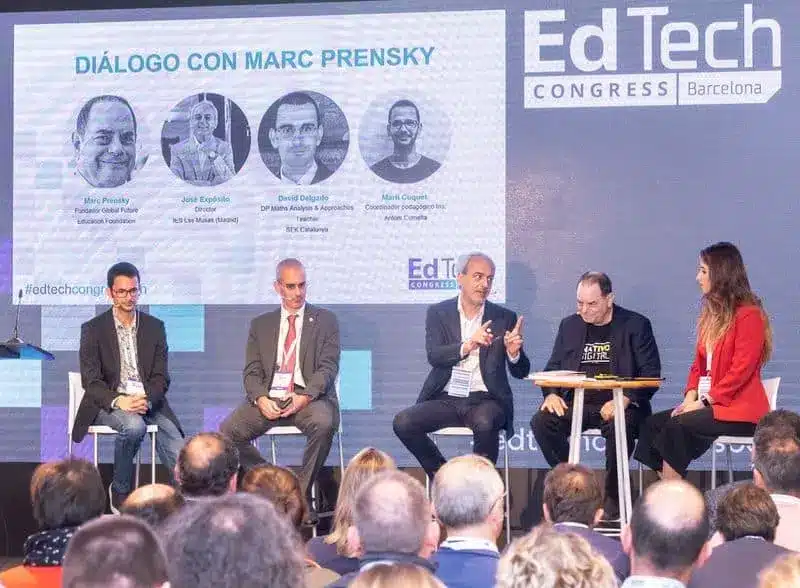
The organizer has already published several prominent speakers on the official upcoming-edition website. Confirmed speaker profiles include Cristóbal Cobo, Senior Education and Technology Policy Expert; Sara Henkelmann-Hillebrand, Head of Market Development for Europe at Epson; Joaquín Goyache, Rector of the Complutense University of Madrid; Ousman Umar, CEO and Co-founder of NASCO Feeding Minds; and Karina Gibert, Full Professor and Co-founder of the Intelligent Data Science and Artificial Intelligence Research Center at UPC.
These speakers represent different perspectives across educational technology, university leadership, social impact, artificial intelligence and digital transformation.
Cristóbal Cobo
Cobo is a senior education and technology policy expert whose work focuses on the relationship between technology, learning and education policy. He has previously delivered major congress sessions examining artificial intelligence and its effect on education and cognition.
Sara Henkelmann-Hillebrand
Her work at Epson focuses on European market development and educational technology, bringing a perspective on digital education, sustainability and technology adoption.
Joaquín Goyache
As Rector of the Complutense University of Madrid, Goyache brings a university leadership perspective to discussions about higher education and institutional transformation.
Ousman Umar
Umar, CEO and Co-founder of NASCO Feeding Minds, contributes a social-impact perspective focused on education, opportunity and technology.
Karina Gibert
Gibert’s background in artificial intelligence and data science provides a strong technical and academic perspective on AI and its role in education.
Conference sessions & tracks
EdTech Congress Barcelona organizes content around the different environments in which education and training take place. This approach makes the congress relevant to school leaders, vocational-training professionals, universities, corporate-learning teams and public authorities.
K-12
The K-12 track examines real classroom applications of AI, digital wellbeing, responsible technology use, teacher roles and active learning methodologies. It focuses on practical questions facing schools as technology becomes increasingly integrated into teaching and administration.
Vocational training
Vocational education sessions explore digital skills, AI adoption, employability, qualifications and the changing requirements of professional training.
University
University sessions investigate AI in teaching, assessment and research, student engagement, institutional innovation and policies governing AI use.
Corporate Learning
Corporate-learning content addresses workforce development, upskilling, reskilling and the use of AI to support continuous professional development.
Public Administration
Public-sector sessions examine educational policy, digital transformation, regulatory questions, interoperability and the responsible deployment of technology.
CTO and digital infrastructure
This area is particularly relevant to technology leaders responsible for connectivity, data governance, digital architecture, interoperability and educational technology ecosystems.
Session times & schedule
The complete timetable for the upcoming edition has not yet been published in full. The organizer is continuing to update the official website with confirmed speakers and programme information, so attendees should use the official agenda as the definitive source once all sessions have been released.
The established congress format normally combines keynote sessions in the main auditorium with parallel specialist sessions, workshops, exhibition activities, technology demonstrations and networking periods.
Previous programming illustrates the format. Sessions have included morning accreditation, opening presentations, keynote conferences, parallel K-12, university and vocational-training discussions, lunch and networking, afternoon roundtables, technology demonstrations and closing presentations.
Main auditorium
High-profile keynote addresses and major conversations are generally placed in the principal auditorium.
Parallel sessions
Specialist sessions allow attendees to choose content according to their professional field, such as K-12, universities, vocational training or public administration.
Networking periods
Coffee and lunch periods are incorporated into the programme to encourage conversations between attendees and exhibitors.
Workshops and demonstrations
Hands-on content and technology showrooms provide opportunities to see educational technology in practical use.
Ticket types & registration
The organizer has not yet published a final public ticket-price table for the upcoming edition. The official website is currently inviting attendees and interested professionals to follow registration updates and receive information about the programme and participation opportunities.
A definitive previous-edition public ticket price could not be verified from the official sources reviewed, so no unsupported historical price is presented here. This is preferable to assigning an estimated amount that the organizer has not published.
Professional attendee
The congress is primarily aimed at education and training professionals, institutional leaders, technology specialists and other members of the EdTech ecosystem.
Educational institutions
Schools, universities and training organizations are central to the congress audience and can participate both as attendees and as contributors to educational use cases.
Exhibitor and sponsor participation
Technology companies can participate through exhibition and sponsorship packages designed to increase visibility and create direct contact with qualified education decision-makers. The organizer currently promotes several sponsorship options adapted to different profiles.
Use-case participation
Educational institutions can also participate in the congress’s call for implemented technology experiences, with subjects including technology-supported assessment, generative AI, personalized learning, educational data, digital competence and digital wellbeing.
Registration deadlines
No final general-attendee registration deadline has been publicly stated on the official upcoming-edition pages. The organizer is currently collecting interest and providing updates about confirmed speakers, the agenda and participation opportunities.
Different participation categories can have separate deadlines.
Attendee registration
Visitors should register through the official congress system as soon as registration becomes available and monitor the organizer’s announcements for capacity limits or changes.
Exhibitor registration
Companies interested in exhibiting or sponsoring can complete the participation form on the official website to receive information about available opportunities.
Use-case submissions
The congress also has a dedicated call for educational institutions to submit implemented technology projects. The official call covers technology-supported assessment, generative AI, personalized learning, educational management and data, digital competence and digital wellbeing.
Exhibitor list & major companies
The final exhibitor list for the upcoming edition has not yet been published. The official website is actively inviting EdTech companies and startups to participate and emphasizes the opportunity to connect with a qualified audience of education leaders and decision-makers.
Previous participation provides a useful picture of the event’s commercial ecosystem. The congress has featured educational technology companies, startups and organizations involved in digital learning, assessment, school management, corporate learning and technology infrastructure.
Companies and organizations appearing in the established programme and wider ecosystem have included Google for Education, Epson, SEIDOR, Additio App, Edebé, Netex Learning and Educaria. These organizations should be treated as previous or programme-associated participants rather than guaranteed exhibitors for the upcoming edition unless the official exhibitor list confirms them.
EdTech companies
The exhibition is designed to give technology providers direct access to education leaders, institutions and professionals.
Startups
Startups can use the congress environment to introduce new educational products and demonstrate innovative approaches to learning technology.
Education technology partners
Larger technology companies can participate through sponsorship, demonstrations, content partnerships and exhibition opportunities.
Exhibition halls & floor plan
The official upcoming-edition website identifies Hall 8 at Fira Barcelona Montjuïc as the congress location. The event is therefore concentrated within the designated congress environment rather than being spread across multiple Fira Barcelona exhibition halls.
The exact final stand-by-stand floor plan has not yet been published. Visitors should consult the official event map and programme once the organizer completes exhibitor allocations.
The established event format includes several functional areas.
Main auditorium
Used for keynote presentations, major conferences and high-level conversations.
Exhibition area
Provides space for EdTech companies and startups to present products and solutions.
Discovery Stage
The congress has previously used a Discovery Stage where attendees could discover educational technology solutions through demonstrations.
Immersive classroom
The immersive classroom provides a practical environment where attendees can experience technology applied to educational settings.
Workshop areas
Hands-on activities provide deeper engagement with educational technology and implementation challenges.
Networking & business meetings
Networking is a major component of EdTech Congress Barcelona. The organizer positions the event as an environment where education leaders, technology companies, institutions and other professionals can establish relationships and exchange ideas.
The congress integrates networking into the programme rather than limiting it to formal business meetings.
Exhibitor networking
Coffee and lunch periods provide opportunities to speak with participating companies and explore technology solutions directly.
Leadership networking
School, university and training executives can compare experiences with peers facing similar digital-transformation challenges.
Business connections
Technology companies can meet qualified decision-makers from educational institutions and public organizations.
Professional community
The congress also connects researchers, policymakers, technology specialists and educators, encouraging discussions that can lead to partnerships and future projects.
The organizer specifically promotes high-level brand positioning, B2B and B2C visibility, networking and connection with the EdTech ecosystem as key benefits for participating partners.
Industry sectors & highlights
EdTech Congress Barcelona covers a broad range of educational and training technology sectors.
Artificial intelligence in education
AI is one of the most prominent subjects, including classroom applications, assessment, governance, research, digital skills and institutional strategy.
K-12 education
School technology, active methodologies, teacher transformation, digital wellbeing and responsible technology are important areas.
Vocational education
Digital skills, employability, certification and AI adoption are central to vocational-training discussions.
Higher education
Universities can explore AI in teaching and research, student engagement, assessment and institutional transformation.
Corporate learning
The congress addresses workforce learning, reskilling, upskilling and continuous professional development.
Educational data
Data governance, analytics, interoperability and digital architecture are relevant to institutions developing technology ecosystems.
Educational assessment
The official use-case programme places particular emphasis on technology-supported assessment, formative learning assessment and evaluation of educational systems.
Digital wellbeing
Responsible technology use and student wellbeing form part of the K-12 focus and wider discussions around educational technology.
Event rules & visitor information
Attendees should follow the official registration and accreditation requirements issued by the organizer. Because the programme includes general conference content, parallel sessions, workshops and activities requiring specific registration, visitors should verify access conditions for each activity before planning their schedule.
Session registration
Some specialist activities may require separate registration or limited-capacity booking. Previous programming has clearly marked selected sessions as requiring advance registration.
Invitation-only activities
Certain professional or evening activities may be invitation-only. Previous programming included an EdTech Night with awards, dinner and networking that was restricted to invited attendees. Such conditions should not be assumed for the upcoming programme until officially confirmed.
Exhibitor access
Companies exhibiting or sponsoring the congress must follow the organizer’s participation conditions and venue requirements.
Use-case participation
Educational institutions submitting projects must meet the eligibility rules specified in the official call, including being a recognized educational institution and submitting an implemented technology experience addressing relevant digitalization challenges.
How to get there
EdTech Congress Barcelona is held at Fira Barcelona Montjuïc, close to Plaça d’Espanya in Barcelona. The official venue information lists Av. Reina Mª Cristina, 08004 Barcelona, as the address.
From Barcelona Sants
Barcelona-Sants railway station connects Barcelona with regional, national and international rail services. From the station, visitors can continue toward Plaça d’Espanya using public transport.
From central Barcelona
Plaça d’Espanya is the principal transport reference point for the Montjuïc venue. From there, the exhibition complex can be reached on foot.
From Barcelona Airport
Travelers arriving at Barcelona-El Prat can use Barcelona’s public transport network or a taxi to reach the Montjuïc area.
By taxi
Taxi travel provides a direct option for attendees carrying equipment, traveling with colleagues or arriving from hotels.
Public transport & parking
The venue has extensive public transport connections. The official congress website identifies Metro lines L1 and L3 with Espanya station as the main metro option.
Metro
L1 and L3 serve Espanya station. This is one of the most convenient ways to reach the Montjuïc venue.
FGC
Ferrocarrils de la Generalitat de Catalunya services including L8, S3, S4, S8, S9, R5, R50, R6 and R60 serve Espanya.
Bus
The official venue information lists TMB services including D20, D40, H12, H16, V7, 13, 23, 46, 65, 52, 79, 91, 109, 150 and 165. Routes should be checked before travel because public transport schedules can change.
Parking
The official event website identifies BSM Rius i Taulet as the parking option for private vehicles. Visitors should check current availability and conditions before driving to the venue.
Accommodation areas
Barcelona offers accommodation across several districts that provide convenient access to Fira Barcelona Montjuïc.
Plaça d’Espanya
This is one of the most practical areas for congress attendees because it is immediately connected with the exhibition venue and major metro services.
Sants
Sants is particularly useful for visitors arriving by train and offers straightforward connections to the venue.
Eixample
Eixample provides a large selection of hotels, restaurants and business services while maintaining good public transport connections.
Poble-sec
Poble-sec is close to Montjuïc and can be convenient for visitors who prefer to stay within walking distance or a short public transport journey from the congress.
Central Barcelona
Areas around Universitat, El Raval, the Gothic Quarter and Passeig de Gràcia offer a wider choice of accommodation and allow attendees to combine professional activities with sightseeing.
Visitors attending as exhibitors or speakers may prefer accommodation near Plaça d’Espanya or Sants because these areas reduce daily travel time and provide convenient access to Barcelona’s wider transport network.
Previous year’s highlights
The previous edition demonstrated the growing scale of EdTech Congress Barcelona. The official congress material reports 2,492 attendees, 34 sessions, 81 speakers, 49 students and 63 exhibiting companies and startups in its previous-edition statistics.
Artificial intelligence
AI was a dominant subject, with discussions covering classroom practice, university teaching, vocational education, governance, assessment and public policy.
K-12 education
Sessions examined responsible AI use, digital wellbeing, active methodologies, teacher transformation and school management.
Higher education
University sessions explored AI for teaching innovation, institutional change and student experience.
Vocational training
The programme included practical experiences from vocational-training centres demonstrating digitalization and artificial intelligence in professional education.
Public administration
Government representatives discussed educational technology pilot programmes, European testing environments, digital transformation and reducing administrative burdens through technology.
Technology demonstrations
Attendees could visit educational technology showrooms, an immersive classroom and the Discovery Stage to see solutions in practice.
Networking
Coffee breaks, lunch periods, exhibitors and dedicated professional activities created opportunities for education leaders and technology providers to connect.
Official registration & tickets
The official EdTech Congress Barcelona website is the primary source for attendee registration, programme updates, speaker announcements, exhibitor participation and sponsorship opportunities. The organizer is currently inviting interested professionals to stay informed about confirmed speakers, the agenda and exclusive opportunities for partners and attendees.
Official EdTech Congress Barcelona website (https://www.edtechcongressbcn.com/)
The event’s participation model includes professional attendance, educational-technology exhibition, sponsorship and institutional involvement. Companies interested in exhibiting or sponsoring can submit their information through the official participation form.
The organizer promotes the congress as a high-visibility environment for reaching a qualified audience of education leaders and executive teams. It also highlights B2B and B2C networking, national and international visibility and connection with the broader EdTech ecosystem.
Educational institutions can also investigate the official use-case call, which recognizes implemented examples of educational technology and digital transformation. Relevant subjects include technology-supported assessment, generative AI, personalized learning, educational data, digital competence and digital wellbeing.
Official contact
Email: info@edutechcluster.org
The organizer’s website should be checked regularly for the final agenda, registration conditions, speaker updates, exhibition information and any changes to access arrangements.
Tickets Sell Out
in Minutes
Maps
Contact
Video
FAQ's
What is EdTech Congress Barcelona?
EdTech Congress Barcelona is a professional education-technology event connecting educators, school and university leaders, technology companies, public administrations and other learning professionals. Its programme combines conferences, workshops, technology demonstrations, exhibitions and networking focused on the future of education and training.
Who should attend EdTech Congress Barcelona?
The congress is designed for education leaders, school executives, university representatives, vocational-training professionals, public-sector decision-makers, corporate-learning teams and EdTech companies. It is also relevant to technology professionals working with AI, data, infrastructure, digital platforms and educational transformation.
What topics are covered at the congress?
The programme covers artificial intelligence, digital education, K-12 learning, vocational training, higher education, corporate learning and public-sector digital transformation. Additional themes include educational data, interoperability, digital wellbeing, assessment, personalized learning and responsible technology use.
Can EdTech companies participate as exhibitors?
Yes. The organizer actively invites EdTech companies and startups to participate through exhibition and sponsorship opportunities. Participating companies can use the congress to demonstrate solutions, strengthen their brand presence and connect with education leaders and other qualified decision-makers.
Does the congress include practical educational technology demonstrations?
Yes. The established programme includes technology showrooms, an immersive classroom, a Discovery Stage and workshops alongside the main conference sessions. These areas allow attendees to move beyond presentations and see how digital tools and educational technologies can be applied in real learning environments.