


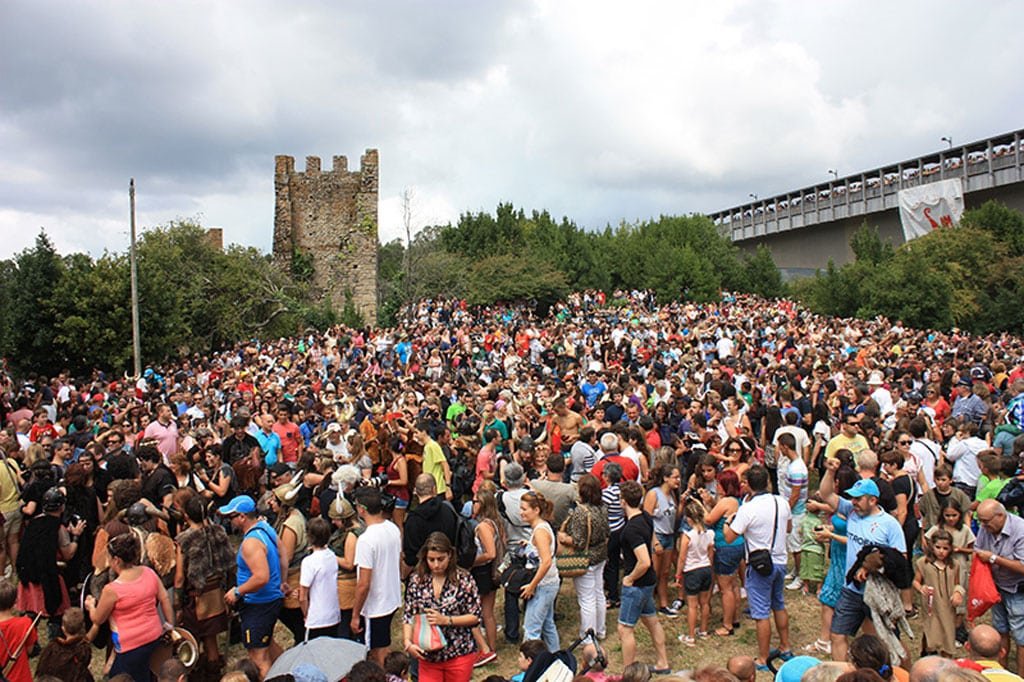
Romería Vikinga 2027 – Catoira, Spain
Overview
Romería Vikinga 2027 is one of Galicia’s most distinctive cultural celebrations, transforming the historic town of Catoira into the setting for a spectacular recreation of Viking raids along the Ulla River. The festival combines history, folklore, theatre, music, traditional food, medieval markets and large-scale outdoor performances around the historic Torres de Oeste.
The central attraction is the dramatic Viking landing, in which participants aboard replica Viking ships arrive at the riverside fortress while local defenders stage a theatrical resistance on land. What was once remembered as a period of conflict has been transformed into a lively celebration of friendship, culture and community.
The festival has a long history dating back to 1960 and has developed from a small cultural gathering into an internationally recognised event. It was declared a Festival of National Tourist Interest and later received International Tourist Interest status, making it one of Galicia’s best-known traditional celebrations.
Enjoy Your Event Stress-Free with Spain Travelo
Planning a trip around a festival, concert, cultural celebration, or business event in Spain can be time-consuming—finding tickets, accommodation, transportation, and local information takes effort. Spain Travelo makes it easier by bringing essential event information, travel planning, and support together in one place.
Romería Vikinga is particularly appealing to visitors interested in Spanish traditions, medieval history, Viking culture, Galician heritage, folklore and unusual cultural festivals. Much of the public programme is designed as an open-air celebration, allowing visitors to experience the atmosphere around the town, river and fortress.
Cultural Significance & Origins
The origins of Romería Vikinga are closely connected with the history of Catoira and its strategic position beside the Ulla River. The Torres de Oeste formed part of the defensive system protecting the approaches to Santiago de Compostela and historically played an important role in resisting attacks by Norman and other raiding forces.
The modern celebration began in 1960 through the efforts of the Ateneo do Ullán, an artistic and literary group. What started as a cultural gathering gradually developed into a larger public celebration. The municipality later took responsibility for organising the event and expanded its programme with theatre, music, cultural activities and other forms of entertainment.
The historical setting is essential to the identity of the festival. Rather than presenting the Viking attacks as a serious historical conflict, the modern celebration turns the story into an entertaining theatrical spectacle. Participants dress as Vikings and local defenders, ships arrive on the river and the battle is recreated in a playful atmosphere.
The festival’s international recognition reflects its importance to Galicia’s cultural tourism. Its International Tourist Interest designation also highlights the importance of Catoira’s historic relationship with Viking heritage and its connections with Frederikssund in Denmark.
Traditions, Rituals & Customs
One of the defining traditions is the Viking landing at the Torres de Oeste. Replica Viking ships approach the riverside site while costumed participants recreate the arrival of the northern warriors. A staged confrontation follows between the Vikings and the defenders of the fortress.
Another important tradition is the use of wine as part of the playful battle. Rather than a realistic violent confrontation, the participants and spectators experience a famously festive spectacle in which wine becomes part of the celebration.
Traditional Galician music is another major element. Folk groups and bagpipe performances contribute to the atmosphere, while medieval-style entertainment and outdoor celebrations connect the modern festival with the region’s cultural heritage.
The medieval market is also an established part of the celebration. Visitors can encounter stalls selling food, drinks, crafts and other products, creating a festive environment around the historical setting.
The Viking Dinner, known locally as Xantar Vikingo, is another distinctive tradition. It brings together large numbers of participants dressed in medieval-style clothing for a communal meal featuring local food. Unlike the main public celebration, this dinner requires access through a specific ticket or registration process when places are released.
What to Expect at the Festival
Visitors can expect a busy outdoor festival atmosphere combining historical reenactment with a large community celebration. The main Viking landing is the visual centrepiece, but the experience extends well beyond the riverbank.
The Torres de Oeste provide a dramatic backdrop for the main activities. The historic remains, river landscape, Viking ships and costumed participants create a setting that feels very different from a conventional modern festival.
Visitors can also encounter folk performances, medieval-style entertainment, food stalls, music, theatrical activities and cultural programming. The wider programme can extend beyond the principal landing, giving the celebration a broader cultural dimension.
One of the most memorable aspects is the participation of local residents. The event is not simply a performance presented by professional actors. Catoira’s community plays a major role in recreating the Viking attack, including the large-scale resistance scene around the fortress. The official programme states that around 200 people participate in the dramatic resistance.
The atmosphere is generally lively and informal, making the event suitable for visitors who want to experience a traditional Galician celebration rather than a formal historical exhibition.
Date & Schedule
Romería Vikinga 2027 is currently listed by Spain’s official tourism portal with its 2027 dates pending confirmation. The official Catoira tourism information confirms that the celebration traditionally takes place during the first week of August, with the main Viking landing staged on Sunday morning.
For planning purposes, visitors should therefore treat August 2027 as the expected festival period rather than a fully confirmed 2027 date until the Concello de Catoira publishes the official programme.
The programme normally develops beyond the main landing and can include concerts, exhibitions, book presentations, talks, sporting activities, theatre and other cultural events during the surrounding festival programme.
The main schedule generally follows this structure:
- Cultural and entertainment activities during the festival programme
- Medieval market and local food activities
- Folk music and performances
- Viking Dinner for registered or ticketed participants
- Vikingmusic and other musical programming
- Viking landing and staged battle at the Torres de Oeste
- Traditional food and drinks
- Outdoor celebrations and evening entertainment
Visitors should check the official Catoira programme before travelling because individual activities, performance times, participation requirements and ticket arrangements can change from one edition to another.
Visiting this event? Don’t miss out on these amazing activities and local experiences while you’re here.
Main Events & Programme
The Viking landing is the principal event. Replica Viking ships approach the Torres de Oeste and costumed Vikings come ashore as part of the theatrical recreation. Local participants then stage the defence of the fortress, creating one of the most visually distinctive cultural performances in Galicia.
The official programme explains that the landing tradition began in 1968. The festival later introduced purpose-built replica Viking ships to make the spectacle more authentic and impressive.
The festival also includes cultural activities surrounding the main event. Concerts, exhibitions, literary presentations, talks and sporting competitions can form part of the wider programme.
The theatrical tradition is particularly important. Catoira established its Theatre Week as part of the festival’s cultural development, with local residents participating in outdoor theatrical productions connected with Viking-era themes and the wider history of the celebration.
Music is another important component. The event’s Vikingmusic programme grew from an earlier festival known as VIKINSONS and features folk and rock performances. The official tourism information states that this musical event has free admission.
Traditional Dress, Arts & Crafts
Costume plays a central role in Romería Vikinga. Participants dress as Vikings, medieval characters and local defenders, helping transform the historic site into the setting for the reenactment.
Visitors can also encounter medieval-inspired clothing and accessories through the festival market. The market provides an opportunity to see crafts, food products and other locally themed goods presented within the festival atmosphere.
The ships themselves are among the most important artistic and historical elements of the celebration. The Torres de Oeste drakkar is based on the Skuldelev 5 vessel discovered in Denmark. According to the official Catoira programme, the replica measures approximately 17.5 metres in length and 2.5 metres in width and was designed with 13 pairs of oars and capacity for a crew of around 30 people.
Another vessel, the Frederikssund, was added to the celebration to accommodate increasing participation and strengthen the connection between Catoira and its Danish sister town. It is approximately 20 metres long and 2.9 metres wide.
A further vessel, the Ardglass-Catoira, was later added to the festival’s Viking fleet, reflecting the celebration’s international connections.
Traditional Food & Local Specialties
Food is an important part of the festival experience and reflects the gastronomic traditions of Galicia.
Mussels are especially associated with the celebration, together with local wine from the Ulla area. These foods are incorporated into the communal atmosphere surrounding the main festival activities.
Visitors can also expect traditional Galician dishes such as octopus, grilled sardines and empanadas. Spain’s official tourism portal specifically highlights these foods as part of the post-reenactment communal celebration.
The medieval market and food stalls provide additional opportunities to sample regional products. Visitors should expect a mixture of traditional Galician cuisine, festival food and drinks rather than a formal restaurant-style dining experience.
The Viking Dinner provides a more organised communal meal and is one of the festival’s distinctive food traditions. It is held in a large tent at the Torres de Oeste area and is designed around medieval-style costumes and traditional local food. Access is subject to the arrangements announced by the organisers for each edition.
Location & Festival Areas
The principal setting is the Torres de Oeste in Catoira, in the province of Pontevedra, Galicia, Spain. The historic fortress stands beside the Ulla River and forms the backdrop for the Viking landing and the main reenactment.
The Torres de Oeste are particularly significant because of their historic defensive role. The original fortified complex contained several towers, although only the remains of two towers survive today. A chapel dedicated to Saint James is also located within the historic complex.
Festival activity is not restricted to the fortress. Catoira itself becomes part of the celebration, with streets, public spaces and other areas used for music, cultural events, markets and entertainment.
The medieval market is traditionally held in the centre of the town, while additional food and drink stalls are placed around the Torres de Oeste during the principal celebration.
Getting to the Festival
Catoira is located in Galicia, in the province of Pontevedra. The town is approximately 37 kilometres from Santiago de Compostela, making Santiago one of the most convenient major cities for visitors combining the festival with a wider trip around Galicia.
Visitors arriving by car can travel toward Catoira and follow local festival signage when the event is taking place. Because the main celebration attracts large crowds, visitors should expect heavier traffic and increased demand for parking close to the main festival areas.
Public transport can also be considered, particularly from larger Galician cities. Visitors should check current railway and bus schedules before travelling because transport arrangements and festival-day services can vary.
Those travelling from outside Galicia may find Santiago de Compostela a convenient arrival point before continuing to Catoira.
Where to Stay Nearby
Catoira is a relatively small destination, so accommodation options may be more limited than in larger Galician cities. Booking early is advisable when planning a trip around the festival.
Visitors can look for accommodation in Catoira itself or consider nearby destinations in the wider Pontevedra and Arousa area.
Santiago de Compostela is another practical option, particularly for travellers who want a larger selection of hotels, guesthouses and apartments. Its proximity to Catoira also makes it useful as a base for exploring other attractions in Galicia.
When selecting accommodation, visitors should consider transport arrangements and the distance from the Torres de Oeste. Staying closer to the festival can make it easier to reach the event early and avoid some of the transport pressure associated with the busiest periods.
What Visitors Can Participate In
Most visitors attend as spectators, but Romería Vikinga has several activities where participation is part of the experience.
The festival atmosphere encourages visitors to dress in Viking or medieval-inspired clothing, particularly when attending communal celebrations. The Viking Dinner is specifically designed around participants wearing period-style clothing.
The public can also experience the medieval market, listen to folk performances, attend concerts and cultural activities, and enjoy the food and social atmosphere around the Torres de Oeste.
Participation in the actual Viking landing is different. The dramatic landing involves organised participants, and the municipality publishes application and admission information for people wishing to take part in the reenactment. Visitors should not assume that anyone can simply join the Viking ships or battle. Official applications and participant lists are used for the organised landing activities.
Things to Do Before or After the Festival
Catoira offers several attractions for visitors who want to spend more time in the area.
The Torres de Oeste themselves are worth exploring because of their historical significance and riverside setting. The fortress provides an important connection to the history that inspired the festival.
Visitors can also explore the natural environment around the Ulla River and the Arousa estuary. Catoira’s surroundings include forests, marshland and river beaches, giving the area a different character from the larger urban destinations of Galicia.
Santiago de Compostela is another major attraction within relatively easy reach. The historic city, cathedral and pilgrimage heritage make it a natural addition to a trip centred on Catoira.
Travellers can also use the festival as an opportunity to explore Galicia’s broader food, wine, coastal and cultural attractions.
Local Food & Restaurants
Galician cuisine is one of the highlights of visiting the Catoira area. Seafood is particularly important because of the region’s proximity to the rivers and estuary.
Visitors should look for local dishes featuring mussels, octopus, sardines, empanadas and other regional specialities. Local wines from the Ulla area also form part of the festival’s traditional food culture.
For meals outside the festival grounds, visitors can explore restaurants and seafood establishments in Catoira and nearby towns. Santiago de Compostela and other larger destinations in the region offer a considerably wider range of dining choices.
During the festival itself, food stalls and market vendors provide a convenient way to sample local products without leaving the event area.
Ticket Information & Access
The main Romería Vikinga celebration is designed as a public cultural festival, and many of its principal outdoor activities are free to attend. The official Catoira tourism information specifically confirms free admission for the Vikingmusic programme.
However, not every activity should be assumed to be free. The Viking Dinner, or Xantar Vikingo, is a separately organised activity requiring tickets or registration when places are released. Official Catoira announcements have included dedicated ticket sales for this event.
The exact 2027 ticket price for the Viking Dinner has not yet been confirmed. Visitors should therefore avoid relying on an unverified 2027 price and should check the official Catoira announcements when ticket sales open.
The Viking landing itself is a public spectacle, but participation as part of the organised crew is controlled through an application process. Spectators should follow official instructions regarding access and safety around the landing area.
Official Event Information
Romería Vikinga is organised by the Concello de Catoira and is officially promoted through the municipality’s tourism resources. Spain’s official tourism portal also lists the event as a Festival of International Tourist Interest and currently shows the 2027 date as pending confirmation.
Official organiser: Concello de Catoira
Official tourism information: Catoira Tourism – Romaría Vikinga
Location: Catoira, Pontevedra, Galicia, Spain
Main festival area: Torres de Oeste and surrounding areas of Catoira
Festival category: Cultural & Traditional
For the latest programme, participation requirements, Viking Dinner tickets and 2027 schedule, visitors should rely on the official Catoira tourism website and municipal announcements.
Tickets Sell Out
in Minutes
Maps
Video
FAQ's
Is Romería Vikinga free to attend?
The main public festival and many of its outdoor activities are generally accessible without an admission ticket. The Vikingmusic programme is officially described as free, while certain activities such as the Viking Dinner require separate tickets or registration.
Where does the Viking landing take place?
The main Viking landing takes place around the Torres de Oeste, the historic fortified complex beside the Ulla River in Catoira. The fortress provides the setting for the arrival of the replica Viking ships and the staged resistance on land.
Can visitors participate in the Viking landing?
Visitors cannot simply join the organised Viking landing as general spectators. Participation in the reenactment is controlled by the organisers, with applications and participant lists published through the municipality's official channels when registration opens.
What food is associated with Romería Vikinga?
The festival is strongly connected with Galician food traditions, including mussels, local Ulla wine, octopus, grilled sardines and empanadas. These foods are incorporated into the communal celebration, while the Viking Dinner offers a separate organised dining experience.
Is Romería Vikinga held every year?
Yes. Romería Vikinga is an annual celebration and has developed into one of Catoira's most important cultural events. The official tourism information describes it as taking place during the first week of August, with the main Viking landing on Sunday morning.