

April Fair 2027 – Seville, Spain
Overview
The April Fair is one of Seville’s most famous cultural celebrations and one of the defining events of Andalusian identity. Known locally as Feria de Abril, the festival transforms the Real de la Feria into a colorful world of decorated casetas, traditional costumes, flamenco-inspired music and dancing, horse-drawn carriages, gastronomy, amusement rides, and social gatherings.
The fair is recognized as a Festival of International Tourist Interest and is one of the most internationally popular celebrations in Seville. Spain’s official tourism portal describes it as a festival where music, food, dancing, and social celebration dominate the city’s cultural life.
Although the modern fair is strongly associated with flamenco culture and Sevillian traditions, its origins were commercial. The event was established as a cattle and livestock fair, before its social and festive character gradually became more important than its original trading purpose. The Municipality of Seville records that the modern fair began with only 19 casetas at the Prado de San Sebastián and subsequently evolved into one of the city’s most important annual celebrations.
Enjoy Your Event Stress-Free with Spain Travelo
Planning a trip around a festival, concert, cultural celebration, or business event in Spain can be time-consuming—finding tickets, accommodation, transportation, and local information takes effort. Spain Travelo makes it easier by bringing essential event information, travel planning, and support together in one place.
Today, the fair is centered on the Real de la Feria, where hundreds of decorated casetas create temporary streets filled with music, dancing, food, drinks, conversation, and social gatherings. Visitors can also experience the horse-and-carriage parade, Calle del Infierno amusement area, traditional performances, and bullfighting at the nearby Plaza de Toros de la Real Maestranza.
One of the most distinctive features is that the casetas are not all open in the same way. Many belong to families, associations, businesses, or groups of friends and are private, while public casetas allow visitors without personal invitations to experience the fair. Spain’s official tourism information specifically recommends checking with the information office at the entrance to identify public casetas.
Cultural Significance & Origins
The April Fair has its roots in Seville’s long history of agricultural and livestock markets. The modern fair was created in the 19th century after two city councillors, José María Ybarra and Narciso Bonaplata, proposed reviving Seville’s traditional fairs.
The Municipality of Seville records that the city received permission for fairs as far back as the reign of Alfonso X, but the modern April Fair was formally approved by the municipal government in the 1840s. The first modern edition was held at the Prado de San Sebastián with just 19 casetas.
What began as a commercial livestock event quickly developed a social dimension. Local residents brought music, food, dancing, and social customs into the fair, eventually making the festive element more important than livestock trading.
The evolution of the fair also influenced Andalusian fashion. The flamenco dress became increasingly established as a symbol of the event, while traditional riding clothing and decorated horse-drawn carriages became central elements of the daytime spectacle.
The fair’s modern identity is therefore a mixture of commercial history, Andalusian popular culture, local social life, music, dance, gastronomy, equestrian traditions, and craftsmanship.
Its cultural significance is particularly strong because the fair is not simply a performance created for visitors. Casetas function as meeting places for local families, associations, companies, and friendship groups. The Municipality of Seville describes the caseta as the heart of the fair, where people eat, drink, sing, dance, and socialize.
Traditions, Rituals & Customs
The Alumbrado
The official opening tradition is the Alumbrado, when the lights illuminating the fairground and the main entrance are switched on. The Portada becomes one of the most recognizable symbols of the celebration, with its design changing from one edition to another.
The Municipality of Seville explains that the Portada serves as the principal entrance to the fairground and is redesigned each year around a different monument, building, cultural reference, or commemorative theme.
The Casetas
Casetas are the social heart of the fair. They are decorated temporary structures where people gather for food, drinks, conversation, music, singing, and dancing.
Most casetas are private and normally require an invitation from a member or an associated person. Public casetas provide an alternative for visitors who do not have local contacts.
Sevillanas
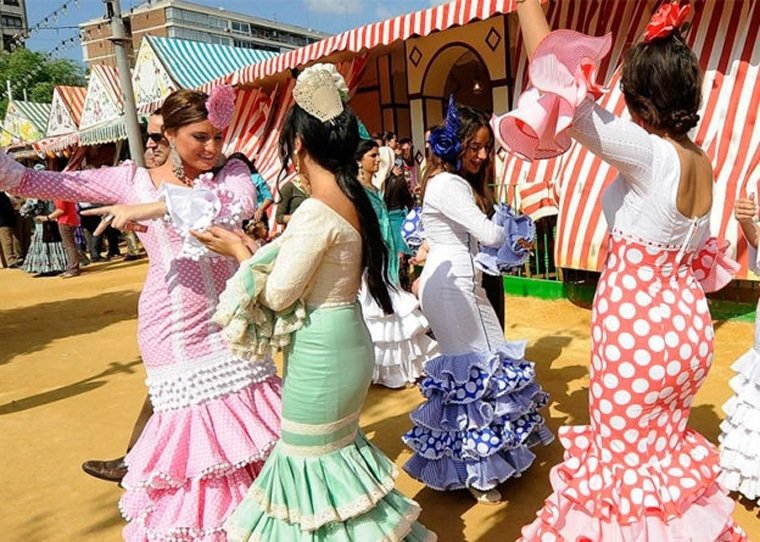
Sevillanas dancing is one of the defining cultural traditions of the fair. It is closely related to flamenco but has its own musical structure and choreography. Dancing often takes place inside casetas as well as in the surrounding streets.
Paseo de Caballos
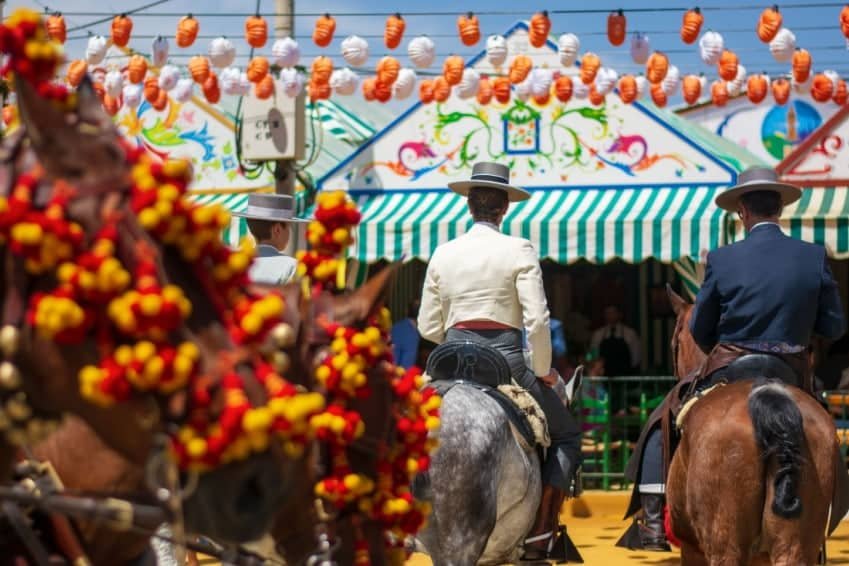
The horse and carriage parade is another major tradition. Riders in traditional clothing and beautifully decorated carriages travel through the Real, creating one of the fair’s most recognizable daytime scenes. The Municipality of Seville regulates carriage access for safety and mobility reasons.
Fireworks
The closing celebration traditionally includes a major fireworks display, providing a spectacular conclusion to the festivities. Spain’s official tourism portal identifies the fireworks as the traditional farewell to the fair.
What to Expect at the Festival
Visitors can expect an exceptionally colorful and energetic atmosphere. The Real de la Feria becomes a temporary city of decorated streets, casetas, lights, music, food stalls, horse-drawn carriages, and amusement attractions.
During the day, the character of the fair is particularly focused on horses, carriages, social gatherings, food, and dancing. Visitors can watch riders and elegantly decorated carriages moving through the designated areas of the Real.
As the evening develops, the atmosphere becomes increasingly focused on music, dancing, socializing, food, and illuminated casetas.
Visitors can expect to encounter:
- Traditional flamenco and Sevillanas dancing
- Andalusian costumes
- Decorated casetas
- Horse riders and carriages
- Traditional food and drinks
- Live music
- Street celebrations
- Amusement rides
- Children’s attractions
- Bullfighting
- Fireworks
- Local social and cultural traditions
The fairground also includes Calle del Infierno, a large amusement area beside the main fairground. The Municipality of Seville describes it as an extensive recreational zone containing mechanical rides, children’s attractions, shows, food stands, games, and other entertainment.
Date & Schedule
April Fair 2027 is expected in April or May 2027 (Dates TBD).
The official Spain tourism listing currently marks the 2027 dates as pending confirmation.
The detailed programme is normally organized around the opening lighting ceremony, daytime horse-and-carriage activity, caseta celebrations, cultural performances, amusement attractions, bullfighting, and the closing fireworks.
Visitors should check the official Seville City Council programme once the final schedule is published because individual activities, opening arrangements, caseta information, mobility measures, and access details can vary.
Visiting this event? Don’t miss out on these amazing activities and local experiences while you’re here.
Main Events & Programme
Alumbrado and Portada
The illuminated entrance is one of the first major experiences of the fair. The Portada is designed as a temporary architectural landmark and becomes especially striking when its thousands of lights are switched on.
The Municipality of Seville has already announced the concept for the 2027 Portada, which will draw on the Pabellón de Marruecos from the 1929 Ibero-American Exposition and the Pino Montano estate associated with the Generation of ’27. The design was created by Hugo Montalbán Ramos.
Caseta celebrations
The casetas form the core of the social programme. Inside them, visitors with access can enjoy food, drinks, singing, dancing, and conversation. Public casetas provide accessible alternatives for visitors without private invitations.
Paseo de Caballos
The horse-and-carriage parade is among the most visually distinctive parts of the celebration. Riders wear traditional equestrian clothing while decorated carriages move through the Real. The Municipality notes that carriage access is controlled through municipal registration for safety and mobility reasons.
Calle del Infierno
This amusement area offers entertainment for children and adults, including mechanical rides, children’s attractions, games, food stands, shows, and other fairground activities. The area occupies a substantial section next to the main fairground.
Bullfighting
Bullfights at the Plaza de Toros de la Real Maestranza form part of the wider Feria experience. Spain’s official tourism portal identifies the bullfight as another important component and notes that tickets and season passes are sold separately through the bullring.
Closing fireworks
A large fireworks display traditionally provides the final spectacle, creating a visual conclusion to the week of festivities.
Traditional Dress, Arts & Crafts
Traditional clothing is one of the most recognizable aspects of the April Fair.
Women commonly wear the traje de flamenca, also known as the flamenco or gitana dress. These dresses are frequently decorated with ruffles, patterns, fitted silhouettes, shawls, flowers, and other accessories.
Spain’s official tourism information notes that the flamenco dress became closely associated with the fair as the event evolved from a livestock market into a major celebration of Andalusian culture.
Men participating in the equestrian traditions may wear traditional riding clothing, including the traje de corto. The Municipality of Seville explains that this outfit originated from traditional countryside clothing associated with working with livestock.
Horse-drawn carriages are also an important example of traditional craftsmanship. The carriages can be highly decorated and are regarded as works of heritage value. The Real Club de Enganches de Andalucía was founded to help preserve Andalusia’s historic carriage tradition.
The temporary Portada is another major artistic feature. Each edition involves a new architectural design inspired by aspects of Seville’s history, architecture, institutions, or cultural heritage.
Traditional Food & Local Specialties
Food is central to the April Fair experience. Casetas function as social dining spaces where visitors and local residents share traditional dishes, drinks, and conversation.
Common fair foods include:
- Fried fish and pescaíto frito
- Jamón ibérico
- Croquettes
- Tortilla española
- Montaditos
- Seafood
- Salmorejo
- Traditional Andalusian tapas
- Local cheeses
- Churros and other sweet treats
The rebujito is one of the best-known drinks associated with the fair. It combines sherry-style wine with a soft drink, ice, and often mint, creating a refreshing drink commonly shared in jugs.
Public casetas provide regulated food and beverage pricing. As a previous-edition reference, official municipal pricing included a 1-liter jug of rebujito at approximately $8.80, a complete adult menu at approximately $16.40, and a children’s menu at approximately $9.35. The 2027 prices have not yet been announced.
Location & Festival Areas
The main festival area is the Real de la Feria in Seville’s Los Remedios district. It is a purpose-built fairground consisting of temporary streets lined with casetas and entertainment areas.
The Real is divided into streets containing the casetas, while the main entrance is marked by the Portada.
Important areas include:
- Real de la Feria
- Portada
- Caseta streets
- Paseo de Caballos
- Calle del Infierno
- Public casetas
- Bullring area around Plaza de Toros de la Real Maestranza
- Los Remedios neighborhood
The Calle del Infierno is a particularly large recreational section. The Municipality describes it as occupying approximately 87,000 square meters, with hundreds of attractions and activities.
Public municipal casetas are distributed across different streets of the Real, including locations associated with city districts.
Getting to the Festival
Seville is well connected by air, rail, road, and long-distance bus services.
Seville Airport provides international and domestic connections, while Santa Justa railway station is the city’s main rail hub and provides connections with other Spanish cities.
The fairground can be reached using local public transport, taxis, walking routes, and special festival transport services.
Because the Real becomes extremely busy, visitors should allow extra time for travel. Temporary traffic restrictions and special mobility arrangements can affect access to Los Remedios and the surrounding streets.
The City of Seville has also developed digital tools for the fair that can help visitors locate casetas, services, and areas of different crowd density. The municipal Sevilla App has included a dedicated fair section with a map of the Real and real-time crowd-density information.
Where to Stay Nearby
Visitors can choose from hotels, apartments, guesthouses, hostels, and other accommodation throughout Seville.
Los Remedios is one of the most convenient areas for visitors who want relatively easy access to the fairground. Triana is another attractive option because it combines proximity with a strong neighborhood identity, traditional food, ceramics, and local culture.
The historic center offers a much broader selection of hotels and tourist accommodation, although reaching the fairground may require public transport or a longer walk.
Accommodation demand is particularly high during the April Fair, so visitors should plan ahead. Properties closest to the Real can command premium prices, while accommodation farther away may provide better value and easier availability.
What Visitors Can Participate In
Visitors can participate in many parts of the April Fair without being local residents.
Public casetas provide the easiest way to experience the traditional social environment without needing a personal invitation. Visitors can eat, drink, listen to music, watch dancing, and enjoy the atmosphere.
Visitors can also:
- Watch the horse-and-carriage parade
- Explore the public casetas
- Learn or watch Sevillanas
- Visit Calle del Infierno
- Enjoy fairground attractions
- Sample Andalusian food
- Explore the Portada
- Attend cultural performances
- Watch the fireworks
- Attend bullfighting with a separate ticket
Spain’s official tourism portal specifically notes that visitors can rent a carriage with a driver through the regular service and participate in the horse-and-carriage experience in this way.
Things to Do Before or After the Festival
Seville offers an extensive collection of cultural attractions beyond the fairground.
Visitors can explore the Cathedral of Seville and La Giralda, the Real Alcázar, the Archivo de Indias, Plaza de España, Parque de María Luisa, Santa Cruz, Triana, and the Torre del Oro.
The Real Alcázar is particularly valuable for visitors interested in the architectural history of Andalusia, while Santa Cruz offers narrow historic streets, plazas, courtyards, and traditional architecture.
Triana is another excellent area to explore because of its connections with ceramics, flamenco, local food, and neighborhood culture.
Visitors can also explore Seville’s wider flamenco tradition. Spain’s official tourism information highlights the city’s importance for flamenco and identifies the April Fair as one of the major occasions for experiencing Andalusian music, fashion, and dance.
Local Food & Restaurants
Seville is one of Spain’s best-known destinations for tapas and Andalusian cuisine. Visitors can find traditional food throughout the historic center, Triana, Los Remedios, and surrounding neighborhoods.
Popular local dishes include gazpacho, salmorejo, fried fish, Iberian ham, croquettes, tortilla, grilled meats, seafood, and seasonal vegetables.
Tapas bars provide a practical option for visitors who want to try several dishes rather than ordering one large meal.
During the fair, visitors can also eat inside public or private casetas. Prices can vary significantly. Previous-edition reporting showed that public casetas had substantially lower regulated prices, while private casetas could charge considerably more for dishes and drinks. For example, previous-edition private-caseta prices included approximately $25 for a plate of ham and approximately $30 for some seafood portions, while public casetas offered lower regulated options.
Visitors without access to private casetas can therefore combine public casetas with restaurants and tapas bars in Los Remedios or nearby districts.
Ticket Information & Access
There is generally no admission ticket for entering the public areas of the Real de la Feria. The fair itself is an open city celebration, and public casetas can be accessed without a private invitation.
The main distinction is between public and private casetas. Most casetas are private and normally require an invitation from a member or associated guest. Public casetas are available for visitors and are identified through official information services.
Food, drinks, amusement rides, carriage experiences, and bullfighting are separate expenses.
For previous-edition pricing, official municipal public-caseta tariffs provided useful reference points. A 1-liter jug of rebujito was approximately $8.80, a complete adult menu approximately $16.40, and a children’s menu approximately $9.35. A beer or soft drink in public casetas was approximately $1.64.
Fairground attractions in the Calle del Infierno were reported at approximately $4.10 for some children’s rides and up to approximately $8.20 for larger attractions, based on previous-edition pricing.
Private caseta prices can be significantly higher and vary according to the establishment. Visitors should not assume that public-caseta tariffs apply throughout the fair.
Bullfighting tickets are also sold separately through the Plaza de Toros de la Real Maestranza.
Official Event Information
Official website: https://www.spain.info/en/calendar/april-fair/
Official tourism contact information associated with the Spain tourism listing includes rrssturismo@tourspain.es.
The Seville City Council provides information on the Real de la Feria, casetas, Portada, horse-and-carriage traditions, public-caseta pricing, entertainment areas, mobility, and visitor services.
For visitors, the most important official information to check before traveling includes the confirmed programme, public-caseta list, mobility arrangements, fairground map, access information, and any updated municipal safety guidance.
Tickets Sell Out
in Minutes
Maps
Contact
Video
FAQ's
Is the April Fair in Seville free to attend?
The main fairground is generally open to the public without an admission ticket, and public casetas can be visited without a private invitation. However, food, drinks, amusement rides, carriage experiences, and bullfighting are separate expenses. Most private casetas require an invitation from a member or guest.
Can tourists enter the casetas at the April Fair?
Yes, but access depends on the type of caseta. Most casetas are privately operated by families, businesses, associations, or groups and require an invitation, while public casetas are open to visitors. Official information at the entrance can help visitors identify public options.
What should visitors wear to the April Fair?
Traditional flamenco clothing is strongly associated with the celebration, especially the flamenco dress worn by women. Men participating in equestrian traditions may wear the traditional traje de corto, while ordinary visitors can attend in normal comfortable clothing. Dressing traditionally is not required for visitors.
What are the main attractions at the April Fair?
The major attractions include the illuminated Portada, decorated casetas, Sevillanas dancing, the horse-and-carriage parade, traditional food, live entertainment, Calle del Infierno amusement rides, bullfighting, and the closing fireworks. The combination of social, cultural, equestrian, and entertainment traditions makes the fair much more than a conventional amusement event.
Where is the April Fair held in Seville?
The main celebration takes place at the Real de la Feria in the Los Remedios area of Seville. The temporary fairground contains streets of casetas, the Portada, the horse-and-carriage areas, and the nearby Calle del Infierno amusement zone. The wider city also becomes involved through restaurants, transport services, cultural activities, and related celebrations.